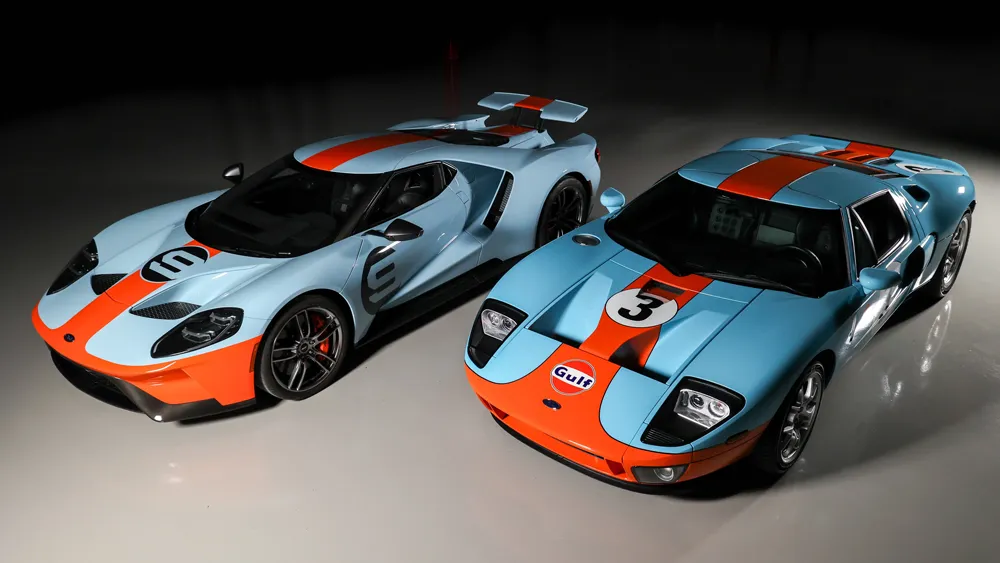
Racing Pedigree Pays Off: Why Ford GT Values Are Poised to Climb
The Ford GT is more than an exotic; it is a factory-bred endurance weapon with Le Mans winning DNA. While both generations of GT hold collector weight, the second-generation GT (2017 to 2022) was engineered specifically to reenter and win modern endurance racing, tying directly to the 2016 Le Mans class victory. From the standard road car to the Heritage Editions and the ultra-rare Lightweight and Carbon Series, this platform was built to echo that return to global competition.
Why It Matters
Beyond rarity and performance, these cars carry visual and technical lineage to real race wins:
- 2016 Le Mans (GTLM class) victory — 50 years after Ford’s legendary 1966 sweep
- 2017 and 2018 Rolex 24 at Daytona class wins
The Liquid Blue and factory graphics found on Heritage and Lightweight editions evoke the factory Ford GTLM entries driven by Sébastien Bourdais, Joey Hand, and Dirk Müller. These links matter to collectors who value road cars that visually connect to successful race programs, even more than the raced chassis themselves in many cases.
The Pattern: Spike, Pullback, Rise Again
Historically, cars tied to significant racing efforts often follow a cycle. Ferrari’s F40, 288 GTO, and Challenge Stradale saw post-launch spikes, pullbacks, and long-term upward trends.
The second-gen Ford GT is showing similar movement:
- 2017 to 2019 Ford GTs surged after the initial allocation period.
- By 2023, the market adjusted. A Carbon Series brought $990K six months after a $1.32M Scottsdale result.
- Today, top-tier GTs range between $950K and $1.15M.
Rienzi Outlook
While the GT lacks Ferrari’s uninterrupted race heritage, it carries a focused and recent success story backed by factory motorsport commitment. That matters, especially when the car is rare, road legal, and visually tied to a podium.
- Standard GTs will stabilize as accessible collector-grade entries.
- Heritage Editions will hold firm due to livery relevance and design.
- Lightweight and Carbon Series will rise over time as the lowest-production, highest-spec variants.
Today’s sub-$1.1M GTs may not be cheap, but they are historically underpriced relative to cars with comparable race lineage and design execution.
If Ferrari’s past is the blueprint, the Ford GT is playing the long game and playing it well.